Fish, carp family
Common bream
- Maximum length
- 82cm
- Maximum weight
- 6.0kg
- Best water temperature
- 14–24 °C
- Fishing districts near where it occurs
- 22

Common bream: the species and fishing rules
About the species Common bream
Length up to82 cmWeight up to6,0 kg
How to recognise it
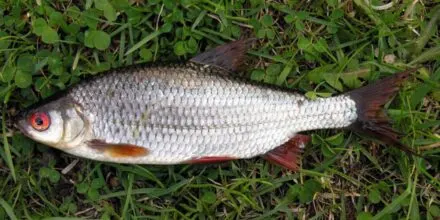
Tall compressed body, long anal fin and silver to bronze colouring with darker fins.
Where it lives
Lowland rivers and reservoirs, in shoals near deeper stretches.
What it feeds on
Insect larvae, plankton, plants.
Spawning
From April to June in overgrown shallows.
An abundant species. Large shoals can be fed with groundbait and fished on the bottom.
Water, occurrence and catches
Water temperature and requirements
At what temperature the species is active and how well today's water suits it.Best temperature14–24 °C
- tolerates 3 to 30 °C
- best 14 to 24 °C
- spawning at 12 to 20 °C
- Length
- up to 82 cm
- Weight
- up to 6.0 kg
- Oxygen
- Typical oxygen requirements
- Position in the food chain
- 3.1omnivore and small animals
The values are indicative and come from the FishBase database. In a particular water, fish behave according to the weather, air pressure, oxygen and food.
Data source: FishBase (Froese & Pauly, Eds.), www.fishbase.se, version 06/2026, licence CC BY-NC.
Where it was recorded
Fishing districts around which a record of this species exists (GBIF).Fishing districts22Basins4
Occurrence by river basin
- Tisza basin11from 1,004
- Danube basin8from 1,142
- Balaton basin2from 73
- Drava basin1from 230
Number of fishing districts with a record of the species and the number of all fishing districts in the basin.
By water type
- Still waters1359%
- Flowing waters941%
The water type determines the close season and the fishing rules of the fishing district.
Fishing districts with a record
- Mosoni Duna folyó (és vízrendszere)
- Mosoni Duna (Feketeerdei holtág)
- Mosoni Duna (Rábca tork.-Kossuth híd)
- Mosoni Duna (Győr-Kos.h.-Pataházi-zs.)
- Duna folyam
- Zala folyó és mellékvizei
- Sió csatorna 98,2 fkm- 122,8 fkm
- Jászsági öntöző főcsatorna szakasz (Tisza-tavi zsiliptől a Kisköre-Füzesabony vasúti hídig)
- Kisbodaki "Kisutcai-tavak"
- Jászsági öntöző főcsatorna szakasz (Kisköre-Füzesabony vasúti hídtól a végszelvényig)
- Kettős-Körös 0+000-37+260 fkm
- Békési téglagyári tó
- Puskaporos-tó (Békés 3720 hrsz.)
- Diófás csatorna, Békés, 6929/6,9 hrsz.
- Borosgyán III tó, homokbánya
- Békési homokbánya tó, Békés 060 hrsz.
- Békési homokbánya, Békés 0103/6 hrsz.
- Borosgyáni IV. tó
- Békési pontyozó
- Ordacsehi berek
- Dunapataj, Szelidi tó
- Gébárti víztározó
22 fishing districts in total. Show on map
Catches of Common bream
Approved catches by anglers on this portal.
Nobody has logged a catch of this species yet. Be the first; once approved it will appear here and on the leaderboard.

In the kitchen and in Europe
Fish in the kitchen
How it tastes, whether it has small bones and how it is cooked.
Flesh
The flesh is tasty but has many small bones.
Cooking
- Smoking
- Frying
Smoked, or fried after very close scoring.
Small bones
Has small bonesTrade names in the EU
The names under which this species is sold in other EU countries.Countries8
- SlovakiaPleskáč vysoký
- CzechiaCejn velký
- AustriaBleiBrachsen
- Hungarydévérkeszegkeszeg
- PolandLeszcz
- GermanyBrasseBlei
- RomaniaPlătică
- ItalyAbramide
- Francebrème
Source: European Commission, commercial designations of fishery and aquaculture products. The names apply when the fish is sold in that country.
Frequently asked questions
Short answers from the data on this page.Questions6
Where does the common bream live?
Lowland rivers and reservoirs, in shoals near deeper stretches.
What does the common bream eat?
Insect larvae, plankton, plants.
When does the common bream spawn?
From April to June in overgrown shallows.
What water temperature does the common bream need?
It does best in water at 14 to 24 °C.
Does the common bream have small bones?
It has small Y-shaped bones that are not removed by filleting.
How is the common bream cooked?
Smoked, or fried after very close scoring.
Photo credits
- Common bream: Photo: Микова Наталия, Public domain, Wikimedia Commons
- Roach: Photo: Scardinius_erythropthalmus1_resize.jpg: Original uploader was Algirdas at lt.wikipedia…, CC BY-SA 3.0, Wikimedia Commons
- Silver bream: Photo: author not stated, CC BY-SA 3.0, Wikimedia Commons
Minimum sizes, protection periods and permitted fishing methods are set by the fishing regulations and the conditions of the specific fishing district. Check them before you fish.